BOP de Huesca · 06 Oct 2026 · 21 vistas
Urban Planning approves modification no. 4 of the Angüés PGOU regarding renewables
Por FactBox Admin
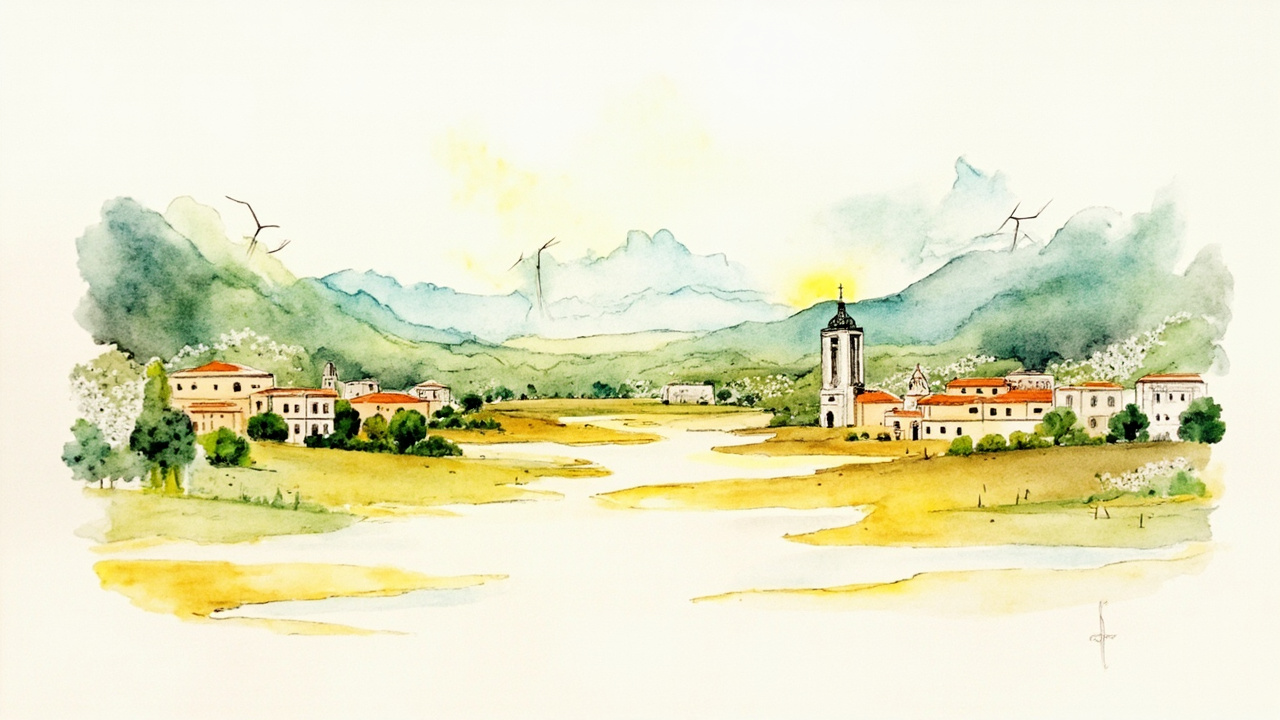
The Provincial Urban Planning Council of Huesca definitively approved on September 23, 2026, isolated modification no. 4 of the General Urban Development Plan (PGOU) of Angüés, intended to regulate energy generation facilities from renewable sources within the municipal district. The agreement is now published in the Official Gazette of the Province of Huesca no. 191, dated October 6, 2026, along with the full text of the urban planning regulations (official reference BOPH-2026-191032).
The publication is carried out in compliance with articles 85 and 57 of the Recast Text of the Urban Planning Law of Aragon and article 18 of Decree 129/2014, of July 29, which approves the Regulations of the Provincial Urban Planning Councils. The file, processed under number 2025/204, involves a lengthy procedure: the initial approval occurred on June 18, 2025, and the Provincial Urban Planning Council of Huesca itself agreed to suspend the definitive approval on March 4, 2026. Following the letter from the City Council of Angüés dated June 19, 2026, containing the technical correction documentation, the deadline for resolution was extended via a resolution published in the Official Gazette of the Province of Huesca no. 147, dated August 4, 2026.
The agreement appears signed in Huesca on October 1, 2026, by the secretary of the Provincial Urban Planning Council of Huesca, Jorge Magallón Rosa, and is inserted in the Autonomous Administration section of the Government of Aragon, under number 4403 and the Department of Housing, Public Works, Logistics, and Territory.
What the modification regulates
The text modifies articles 76 and 77 of the PGOU, relating to generic non-developable land and agricultural-livestock use, and incorporates a series of newly created articles dedicated to each type of installation:
- Art. 82 bis: solar parks.
- Art. 82 ter: wind farms.
- Art. 82 quater: hybrid parks (solar and wind).
- Art. 82 quinquies: biomethane plants.
- Art. 82 sexies: hydrogen extraction or exploitation plants.
- Art. 82 septies to 82 duodecies: interpretation, processing, environmental measures, and aeronautical easements.
Installations may only be located on generic non-developable dryland classified as arable land. For agricultural-livestock use, a minimum setback of 5 meters from all boundaries and a maximum height of two stories (6.5 meters) is required, and livestock farms must be located more than 2 kilometers from the nearest wind turbine.
Distances and limits for solar and wind parks
Solar parks will have a maximum continuous occupation of 5 hectares for collection modules, up to a maximum of 20 hectares per park, and self-consumption parks may not exceed 10,000 square meters. The following protection distances, among others, are established:
- 1 kilometer around urban or developable land: only self-consumption solar parks.
- 500 meters from scattered housing and livestock activities.
- 500 meters from highways and 200 meters from national roads.
- 200 meters from the axis of livestock trails.
- 1 kilometer between solar or wind parks.
In the case of wind farms, each park will have a maximum of 8 wind turbines, with a minimum separation between them of three times the rotor diameter and a minimum height of 30 meters between the ground and the lowest point of the blade sweep. A minimum distance of 2 kilometers from towns, farms, and isolated dwellings is required, 1 kilometer from the axis of the Alcanadre riverbed, and 500 meters from irrigation ponds or reservoirs. Wind turbines may only be located south of the east-west line formed by the A-22 highway, 1 kilometer away from it.
Biomethane, hydrogen, and aeronautical easements
Biomethane plants are limited to 2 hectares and must be located more than 3 kilometers from the boundaries of urban or developable land; hydrogen plants, to 1 hectare and more than 2 kilometers. Both will only be authorized if they can transfer the obtained gas to the gas pipeline that crosses the municipality, and their new electrical supply lines will be buried. The maximum dosage of digestate in direct application will be 170 kilograms of nitrogen per hectare.
The articles also incorporate the environmental measures of the resolution of the Aragonese Institute of Environmental Management (INAGA) of November 5, 2025, and the determinations of the report from the Directorate General of Civil Aviation of December 23, 2025. The entire municipal district of Angüés is affected by aeronautical easements associated with radio-electric installations for air navigation in the case of wind turbines (Royal Decree 716/2023), and part of it by those of the Huesca-Pyrenees airport (Royal Decree 1422/2018). Therefore, the execution of constructions, installations, or plantations will require prior favorable agreement from the State Aviation Safety Agency (AESA), in accordance with Law 48/1960 and Royal Decree 369/2023.
Impact for owners
The modification provides the municipality of Angüés, comprising the nuclei of Angüés, Bespén, and Velillas, with its own regulatory framework to manage the arrival of photovoltaic, wind, and renewable gas projects, following more than a year of processing and a previous suspension. The new articles condition the uses of non-urbanizable land, impose protection distances from homes, farms, and roads, mandate the undergrounding of evacuation lines, and subject each project to municipal and sectoral authorization, with special attention to the aeronautical easements that cover the entire district.
Source: Official Gazette of the Province of Huesca, no. 191, October 6, 2026, Autonomous Administration, pp. 57-73 (official reference: BOPH-2026-191032).