BOP de Sevilla · 23 Oct 2026 · 6 vistas
Seville initially approves the ordinance on the uses of the Plaza de España
Por FactBox Admin
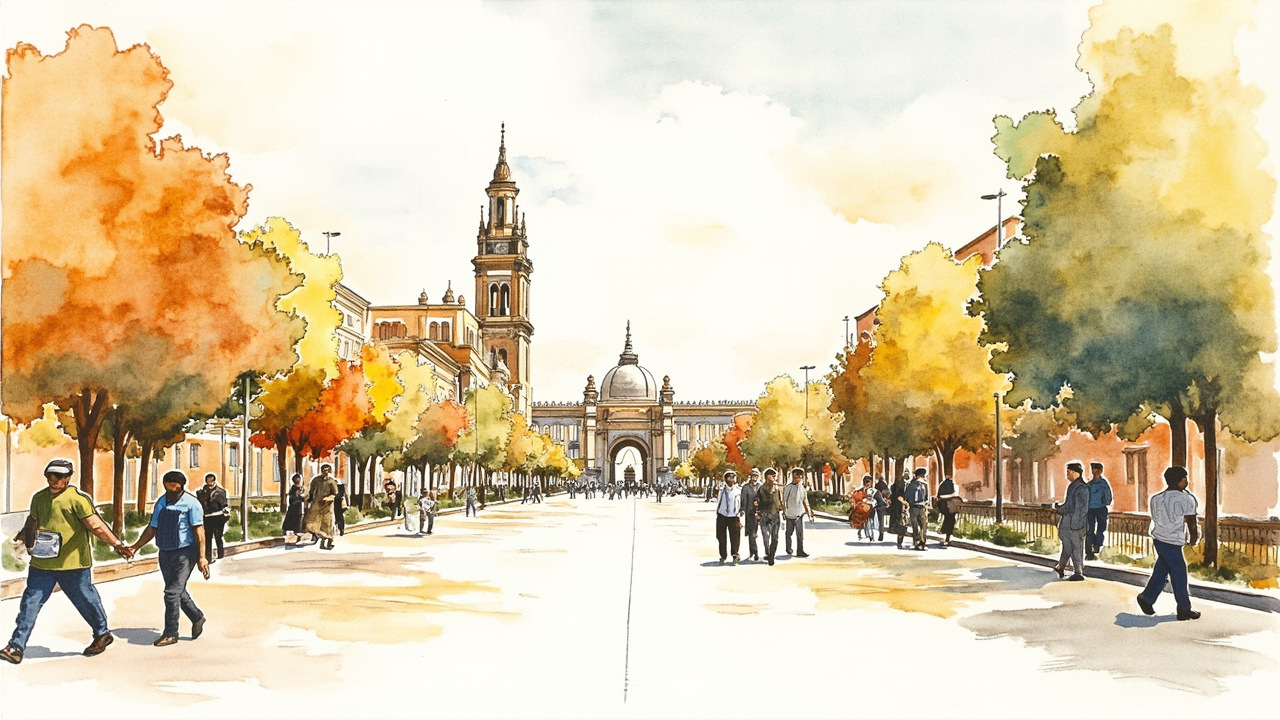
The Local Governing Board of the Seville City Council initially approved on October 16, 2026, the Draft Regulatory Ordinance for the Use of the Plaza de España Monumental Complex. The agreement is published in the Official Gazette of the Province of Seville No. 206, dated October 23, 2026, under the official reference BOP-SE-2026-206020, and opens a period of 30 business days to submit allegations, suggestions, and claims.
The regulation reaches the gazette following a file processed by the Urban Planning and Environment Management (GUMA) under reference 640/2025 DT. The text consists of a statement of reasons, five titles with 40 articles, four final provisions, one transitional provision, and three annexes: mapping and delimitation of the area, general technical guidelines, and minimum application documentation.
The administrative process includes a prior public consultation held between October 31 and November 30, 2025, with 317 contributions. The Economic and Social Council of Seville (CESS) did not issue an opinion in its plenary session on July 1, 2026—18 votes in favor, 18 against, and 2 abstentions, following a comprehensive amendment by the Confederation of Entrepreneurs of Seville (CES)—and reports were incorporated from the GUMA Secretariat (July 30, 2026), the Comptroller’s Office (September 11, 2026), and an economic-financial impact report (September 22, 2026). The GUMA Governing Council approved the project on October 6, 2026, and forwarded it to the Local Governing Board.
Which space and which acts are regulated
The scope covers the open space of the Plaza de España—the area known as Gran Peatón, the four bridges, the creek, and the central space—and the adjacent access roads:
- Avenida de Isabel la Católica, between the San Diego and Covadonga roundabouts.
- Avenida de Rodríguez de Casso, between Avenida de Isabel la Católica and the Marineros Voluntarios roundabout.
The ordinance regulates temporary occupation by public or private entities for public acts, cultural or educational events, festivals, concerts, and music and performing arts shows, provided they serve cultural, recreational, tourist, or social interests of proven relevance. The public domain authorization will also require, where applicable, an occasional activity license and sectoral reports on heritage, security, mobility, cleaning, and the environment.
Excluded are outdoor advertising, street vending and kiosks, traditional festivals such as Holy Week and the April Fair, electoral acts, audiovisual filming, activities of minor significance, and those with purely commercial or promotional purposes.
Application deadlines and occupation limits
Promoters must submit their application with a minimum notice period that varies according to the duration of the event:
- Events of less than one week: 45 calendar days.
- Between one and three weeks: 2 calendar months.
- Three weeks or more: 3 calendar months.
- Multi-year or unique events: 9 calendar months.
The maximum occupancy shall be 45 calendar days per calendar year, including assembly, celebration, and disassembly; if several events are linked without interruption, the total may not exceed 60 days. In cases of special complexity, 45 days of activity plus 15 additional days for assembly and disassembly are permitted, and after disassembly, the space must remain vacant for at least one calendar month. Modifications requested by the promoter must be registered 15 business days prior to the start of assembly.
Annex II establishes technical limits: structures may not occupy more than 50% of the available free space nor exceed 50% of the average height of the venue’s facades, with a minimum separation between installations and monumental facades.
Governance and Sanctioning Regime
The Coordination Steering Committee of the Plaza de España is hereby created, a collegiate advisory body chaired by the head of the GUMA Management and composed of the general directorates of Culture, Heritage, and Tourism of the City Council, with a GUMA official serving as secretary, with a voice but no vote. It shall meet ordinarily every semester, and its reports shall be technical and non-binding in nature.
The sanctioning regime provides for fines from 60 to 3,005 euros for minor infractions, from 3,005.01 to 15,025 euros for serious infractions, and from 15,025.01 to 30,050 euros for very serious infractions, which may be accompanied by the termination or revocation of the authorization. Holders must provide a guarantee when required and maintain a valid civil liability insurance policy throughout the event.
Allegations and Entry into Force
Allegations may be submitted for 30 business days from the day following publication, at the General Registry of GUMA, through its electronic platform for document submission, and by the other means specified in article 16.4 of Law 39/2015. The full text and its annexes will be published at www.urbanismosevilla.org.
The ordinance shall enter into force 15 days after its full publication in the Official Gazette of the Province of Seville, once definitively approved. The agreement is signed by Juan de la Rosa Bonsón, Deputy Mayor delegated for Urban Planning, Environmental Protection, Heritage, and Housing, exercising the powers of Mayoral Resolution No. 921, dated September 30, 2024.
The regulation directly affects cultural promoters, event companies, and residents in the vicinity of the María Luisa Park, declared a Site of Cultural Interest: it establishes for the first time a calendar, deadlines, and occupancy limits for a venue that until now was governed by the 2007 general ordinance for public spaces of the historic center, and transfers to the BOP a framework that must be specified in the venue’s annual programming.
Source: Official Gazette of the Province of Seville, no. 206, October 23, 2026, Local Administration, page 135 (official reference: BOP-SE-2026-206020).