JORF · 07 Nov 2026 · 59 vistas
Penly: environmental authorization for EPR2 preparatory works adjusted by decree
Por FactBox Admin
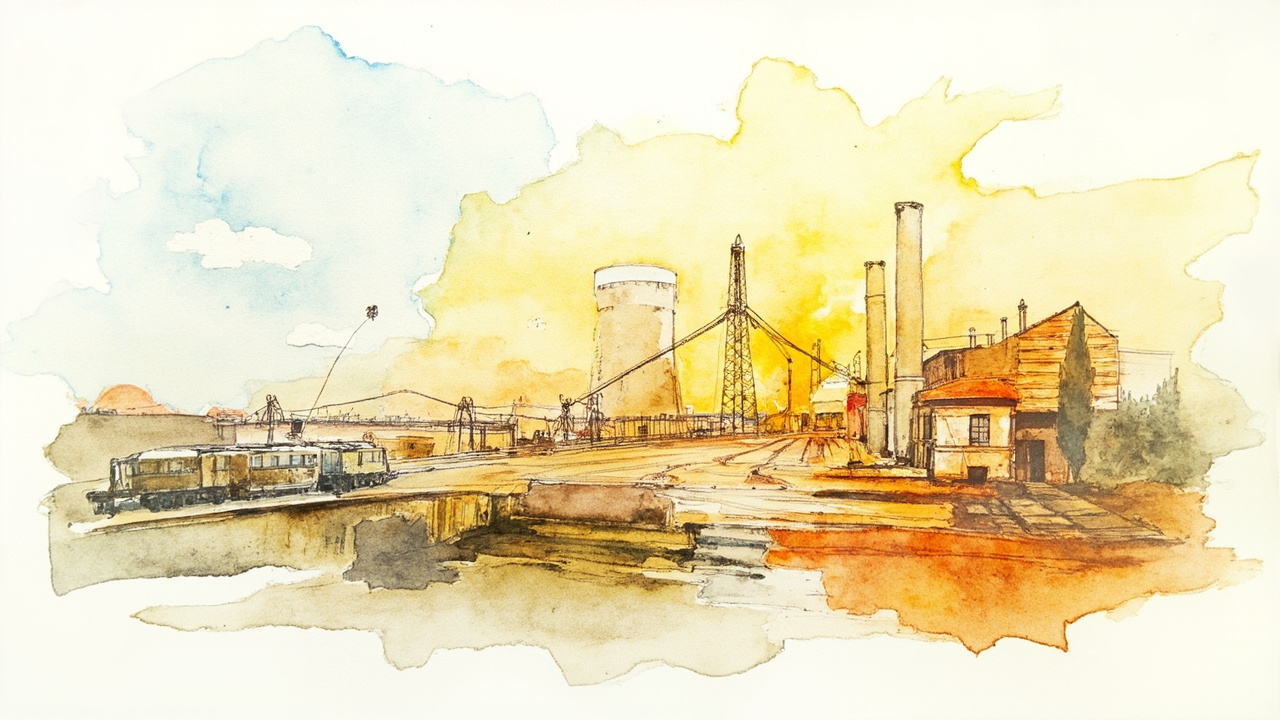
The Official Journal of the French Republic published, in its November 7, 2026 edition (JORF No. 0261), Decree No. 2026-1035 of November 6, 2026, which modifies the environmental authorization for the preparatory works of the pair of EPR2 type nuclear production units at the Penly site, in the municipality of Petit-Caux. The text, signed under NOR: TECP2629230D by the Ministry of Ecological Transition, Biodiversity, and International Negotiations on Climate and Nature, rewrites approximately twenty articles of Decree No. 2024-505 of June 3, 2024. It consolidates the avoidance, reduction, compensation, support, and monitoring measures into a single act, and explicitly adds the operating authorization under the regulations for installations classified for the protection of the environment (ICPE) to the scope of the construction site.
A three-phase construction site reclassified as a classified installation
The decree completes Article 2 of the 2024 text by mentioning, among the enforceable elements, “the implementation of the avoidance, reduction, compensation, support, and monitoring measures annexed to this authorization,” and by inserting the “operating authorization under the regulations for installations classified for the protection of the environment.”
The nomenclature is entirely rewritten: groundwater withdrawals (heading 1.1.2.0-1, authorization regime), construction site wastewater treatment plant (2.1.1.0-2), stormwater discharges over a catchment area of approximately 235 hectares (2.1.5.0-1), sea discharges exceeding 100,000 m³/day (2.2.2.0), maritime works exceeding 1.9 million euros (4.1.2.0-1), and dredging (4.1.3.0-3b).
Regarding risks, the establishment falls under the Seveso lower-tier status via the aggregation rule, including notably:
- 3,000 kg of category 1 acute toxicity products (heading 4110-2-a);
- 2,400 tonnes of petroleum products (4734-2-a);
- 2 tonnes of hydrogen and 3 tonnes of acetylene (4715-1 and 4719-1);
- 30 tonnes of liquefied flammable gases (4718-1-b).
The decree further specifies that the construction site consists of three major phases—preparatory works, civil engineering, and electromechanical assembly—and that the development of the platforms may continue throughout the duration of the project.
Water, dredging, and marine discharges under quantified requirements
Withdrawals related to the dewatering of excavation bottoms are capped at an average flow rate of 1,000 m³/h, with a maximum of 2,000 m³/h in the event of heavy precipitation. The construction site’s wastewater treatment plant capacity increases from 1,000 to 4,500 population equivalents, for a load of approximately 270 kg/day of BOD5 and a reference flow rate increased from 308 to 675 m³/day.
The initial dredging of the intake channel is estimated at approximately 100,000 m³, with maintenance campaigns remaining under 200,000 m³ over twelve consecutive months. Sediments may only be submerged if they comply with the N1 reference level, at a site located approximately 3 miles offshore from the nuclear center, covering an area of about 1.5 km² and with a depth of 12 to 17 meters.
Alert and stop thresholds are set for discharges before release into the sea: 8 then 10 mg/L of total hydrocarbons, 30 then 35 mg/L of suspended solids, 115 then 125 mg/L of COD. Quarterly monitoring of global beta, potassium 40, and tritium is planned, with thresholds of 0.5 Bq/L and 25 Bq/L.
Protected Species: Fourteen Compensation Sites
Title VI of the decree becomes “Special requirements relating to protected species and habitats.” It lists eleven reduction measures (MR1 to MR11, plus MR29 for the Herring Gull), five measures specific to the Berneval parking lot, and the compensation measures.
The compensation sites, numbering fourteen, notably include:
- the restoration of the Hares and Camp César sites in Petit-Caux;
- the Mât Pavillon and Parfondval valleys in Petit-Caux;
- the Mesnil valleys in Criel-sur-Mer;
- the côtes Saint-Ouen hillside in Saint-Ouen-sur-Bailly;
- plots AL33 in Saint-Aubin-sur-Scie.
Land clearing increases from 5.28 to 5.33 hectares, and compensation from 10.56 to 10.66 hectares, incorporating 500 m² related to the maintenance track of basin A7.
Waste, Governance, and Urban Planning
Waste is capped at 300,000 tonnes of inert waste, 18,000 tonnes of non-hazardous waste, and 2,000 tonnes of hazardous waste per year, with the operator required to optimize the reuse of excavated materials with full traceability; the storage capacity for inert materials reaches 640,000 m³. The site plan and biodiversity monitoring become semi-annual.
The Nuclear Safety and Radiation Protection Authority is added to the organizations receiving information. After the cessation of activity, the future use of the Lombardie, Berneval, and Trapèze plots, owned by EDF, will be agricultural, while other plots will remain for industrial use; the developments in the Lombardie sector and the Berneval-le-Grand parking lot remain subject to specific urban planning authorizations.
The scope of the text is twofold: for the residents of Petit-Caux and Berneval, it establishes measurable thresholds and an enforceable monitoring schedule; for the industry, it legally secures the preparatory phase of the EPR2 pair by fully attaching it to the regime of classified installations, while the annexes of the decree are published in the Official Bulletin and available for consultation at the general directorate for risk prevention and at the Seine-Maritime prefecture.
Source: Official Journal of the French Republic, JORF No. 0261 of November 7, 2026, decree No. 2026-1035 of November 6, 2026 (NOR: TECP2629230D).