Boletín Oficial de la Ciudad Autónoma de Ceuta · 01 Sep 2026 · 6 vistas
Ceuta approves protocol for ammonia leaks at the port
Por FactBox Admin
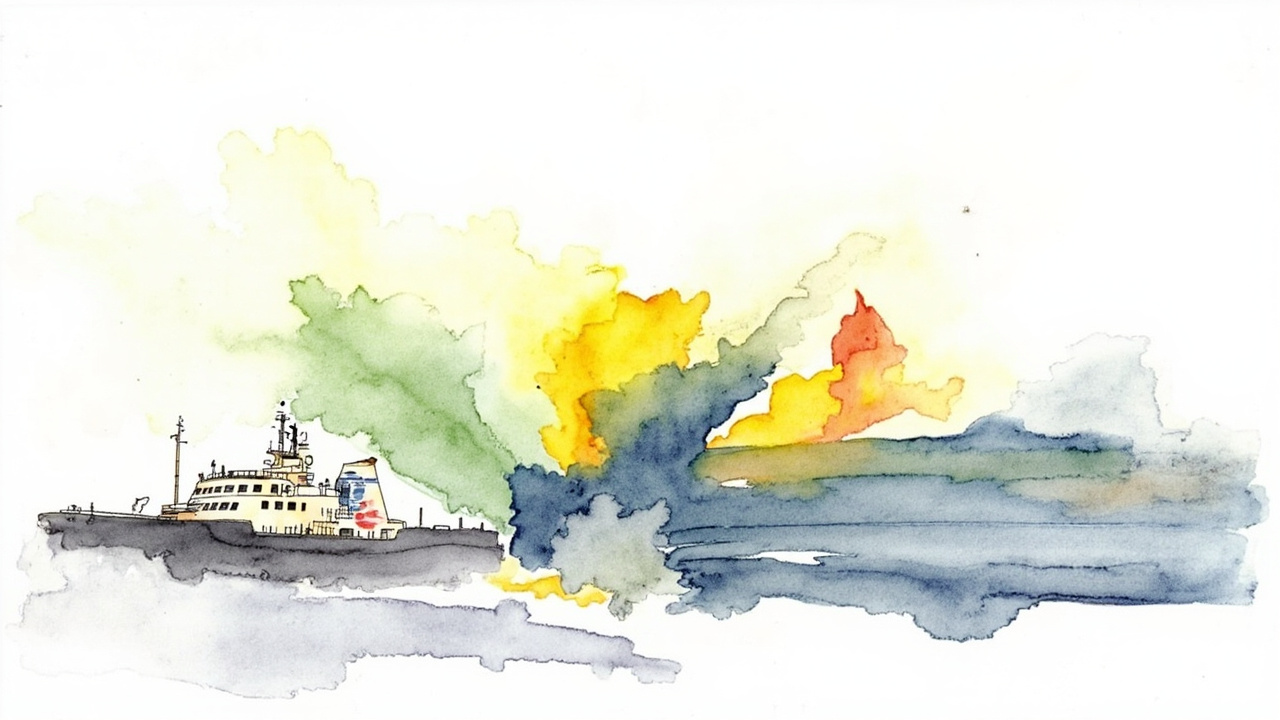
The Autonomous City of Ceuta has approved a Civil Protection technical instruction to manage accidents involving anhydrous ammonia in the port area, a propulsion fuel for the merchant navy that can be stored in quantities of up to 1,400 tons on ships anchored next to the city. The regulation is published in the Official Gazette of the City of Ceuta (BOCCE) No. 6,648, dated September 1, 2026, via Decree 613 from the Councilor for Presidency and Governance, Mr. Alberto Ramón Gaitán Rodríguez, dated July 20, 2026.
The decree approves the Annex to Civil Protection Technical Instruction 2026-004 (ITPC: 2026-004), developed by the City’s Civil Protection Service, which protocolizes preventive and self-protection actions for the citizenry regarding the danger posed by the use of anhydrous ammonia (NH3) as a propulsion fuel, especially by the merchant navy.
A New Risk in the Strait
Anhydrous ammonia is a colorless, easily liquefiable, toxic, and corrosive gas that causes severe chemical burns, blindness, pulmonary edema, and even death through inhalation or direct contact. It is being promoted as an alternative to fossil fuels within the framework of Regulation (EU) 2023/1805 and the European Green Deal, which seeks to reduce emissions from maritime transport, currently responsible for 3% of global greenhouse gas emissions.
Ceuta’s uniqueness lies in the fact that its population lives adjacent to the coast and the port is integrated into the urban layout. A “handymax” type vessel anchored in the northern bay or docked at the west or east quays can store approximately 1,400 tons of ammonia, and ships are not required to declare the type of fuel they use upon docking or anchoring.
Scenarios and Action Procedure
The instruction considers that a leak—caused by collision, ineffective maintenance, or incompetence—would generate a toxic cloud that would reach the population in minutes, depending on the wind. In response, the procedure provides for:
- The Ceuta 112 Emergency Room will issue a massive Es-Alert confinement notice, with prior authorization for this situation.
- The Ceuta Territorial Emergency Plan (Platerce) will be activated in Phase 2, Operational Situation 2.
- A CECOPI (Emergency Coordination Center) will be established via a cloud videoconference room, arranged by Telecommunications and the Information Society (TSI).
- The Ceuta SEIS (Emergency Services) will activate its internal contingency plan and operational strategies for the incident.
Recommendations to the Population
The annex collects the Civil Protection recommendations for anhydrous ammonia (UN Number 1005, NIP 268): it is corrosive, toxic by inhalation, forms an explosive mixture with air, and can attack metals. The alert message to the public orders not to go out or remain outdoors, to shelter in place, to prevent street air from entering, and to place wet towels in the gaps of doors and windows.
The regulation is issued within the framework of the City’s competence in Civil Protection matters, in accordance with the Statute of Autonomy of Ceuta (Organic Law 1/1995), Law 17/2015 of the National Civil Protection System, and Royal Decree 524/2023, which approves the Basic Civil Protection Standard. The resolution exhausts the administrative route and may be appealed for reconsideration within one month or before the Contentious-Administrative Court of Ceuta within two months.
The instruction makes Ceuta a benchmark in the anticipation of an emerging risk: in the event of an ammonia leak, the entire coastal and port population would be subject to confinement; therefore, the prior preparation of operational services and warning systems is essential to minimize damage.
Source: Official Gazette of the City of Ceuta (BOCCE), no. 6,648, September 1, 2026, General Provisions, page 3298 (official reference: Decree 613, ITPC: 2026-004).