JORF · 27 Oct 2026 · 3 vistas
Three fires in Gironde and Landes recognized as large-scale disasters
Por FactBox Admin
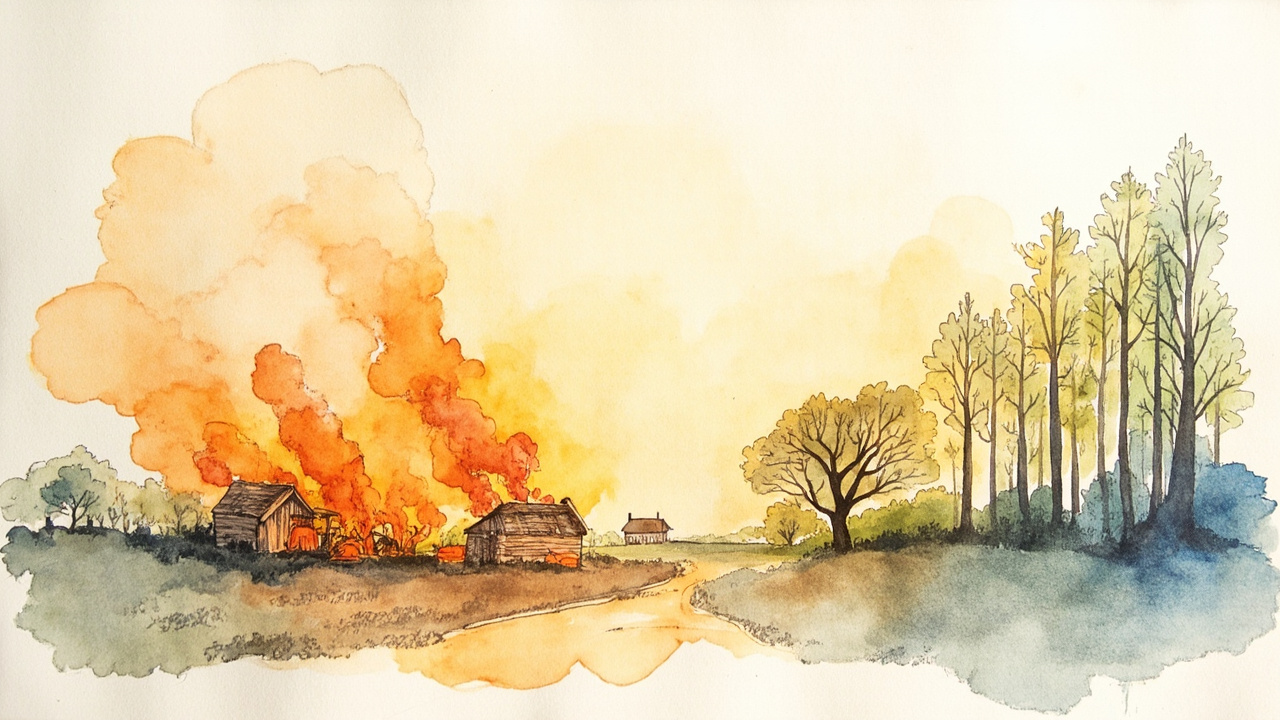
A decree dated October 23, 2026, from the Ministry of Ecological Transition, Biodiversity, and International Negotiations on Climate and Nature classifies the fires in Saumos, Biscarosse, and Luglon, which occurred this summer in Gironde and Landes, as a “large-scale disaster.” Published in the Official Journal of the French Republic on October 27, 2026 (JORF No. 0251, NOR TECT2627193A), the text exempts cleanup work in the affected forests from the obligation to hold a sustainable management document. It amends the decree of July 31, 2026, regarding the recognition of a large-scale disaster concerning forest fires in these two departments.
Three fire outbreaks, one common classification
Article 1 of the decree of July 31, 2026, is replaced in its entirety. The new wording precisely lists the three targeted fires, along with their start dates:
- the so-called Saumos fire, which began on July 22, 2026;
- the so-called Biscarosse fire, which began on July 23, 2026;
- the so-called Luglon fire, which began on August 13, 2026.
The text notes that these three fires, “in the departments of Gironde and Landes,” constitute a large-scale disaster. The wording is identical for the three sites: the classification is therefore not based on a separate assessment of the areas burned, but on a global recognition.
The scale of the two main hotspots is documented elsewhere in the Official Journal. According to the opinion of the National Consultative Commission on Human Rights (CNCDH) published on October 1, 2026, the Saumos and Biscarrosse fires alone covered approximately 45,600 hectares—42,000 for the first, approximately 3,600 for the second—destroyed approximately 240 homes, and led to the evacuation of approximately 250,000 people, described as the largest operation of its kind carried out in France outside of a conflict context.
The exemption unlocking cleanup aid
Article 2 of the decree of July 31, 2026, is supplemented by a new paragraph, which removes a prior administrative condition. “By derogation provided for in Article L. 121-6 of the Forestry Code,” the benefit of public aid intended for cleanup work in forests affected by the fires referred to in Article 1 is not subject to the existence of one of the sustainable management documents mentioned in Articles L. 124-1 and L. 124-2 of the Forestry Code.
In concrete terms, a forest owner whose stand has burned can therefore access this funding without producing a simple management plan, a standard management regulation, or an equivalent document. The exemption is strictly limited: it applies only to cleanup work in forests affected by the three specifically designated fires, and not to all forestry aid.
A mechanism built in several stages since the summer
This recognition is part of a regulatory framework established over a few weeks. Decree No. 2026-937 of October 8, 2026 (NOR TECT2624353D, JORF No. 0237 of October 10, 2026) applies Article L. 121-6 of the Forestry Code and establishes a system of aid for forest renewal; it specifically identifies a fire occurring less than five years before the application and having been the subject of a finding of large-scale damage as an eligible forestry situation.
The Order of October 8, 2026 (NOR TECT2624357A) specifies the technical thresholds: the fire condition is met when the fire affects more than 80% of the area and has destroyed more than 20% of the dominant or future trees. It also sets the flat-rate tariff used as the basis for calculating the aid.
In parallel, support for affected businesses has been extended. Decree No. 2026-776 of August 14, 2026 (NOR TRSD2621987D) created exceptional aid for companies with fewer than 250 employees that were evacuated or confined, and Decree No. 2026-874 of September 17, 2026 (NOR TRSD2624056D) extended the mechanism until October 4, 2026, with municipal annexes including Saumos, Biscarrosse, Luglon, Garein, Parentis-en-Born, and Sanguinet for the Landes region.
What this changes for foresters in the Southwest
For forest owners in the Gironde and Landes massifs, the effect is twofold. The qualification of large-scale damage anchors the affected plots within the scope of the forest renewal aid regime opened by the decree of October 8, 2026, within the five-year window provided for burned stands. The exemption introduced on October 23 removes the most frequent practical obstacle for small, fragmented properties, which often lack an approved management document.
The timing is not neutral: the order was signed four days before it was published, at the end of a season where burned areas reached an unprecedented level. However, the text does not create new credits and does not open a filing deadline: it only conditions access to existing aid, as applications must satisfy the requirements of the decree and the order of October 8, 2026.
Source: Official Journal of the French Republic, JORF No. 0251 of October 27, 2026, order of October 23, 2026 amending the order of July 31, 2026 recognizing a large-scale disaster concerning forest fires in the departments of Gironde and Landes, NOR TECT2627193A.