Boletín Oficial de Canarias · 27 Oct 2026 · 9 vistas
The Canarian Government executes the Lomo Gordo 4 photovoltaic park
Por FactBox Admin
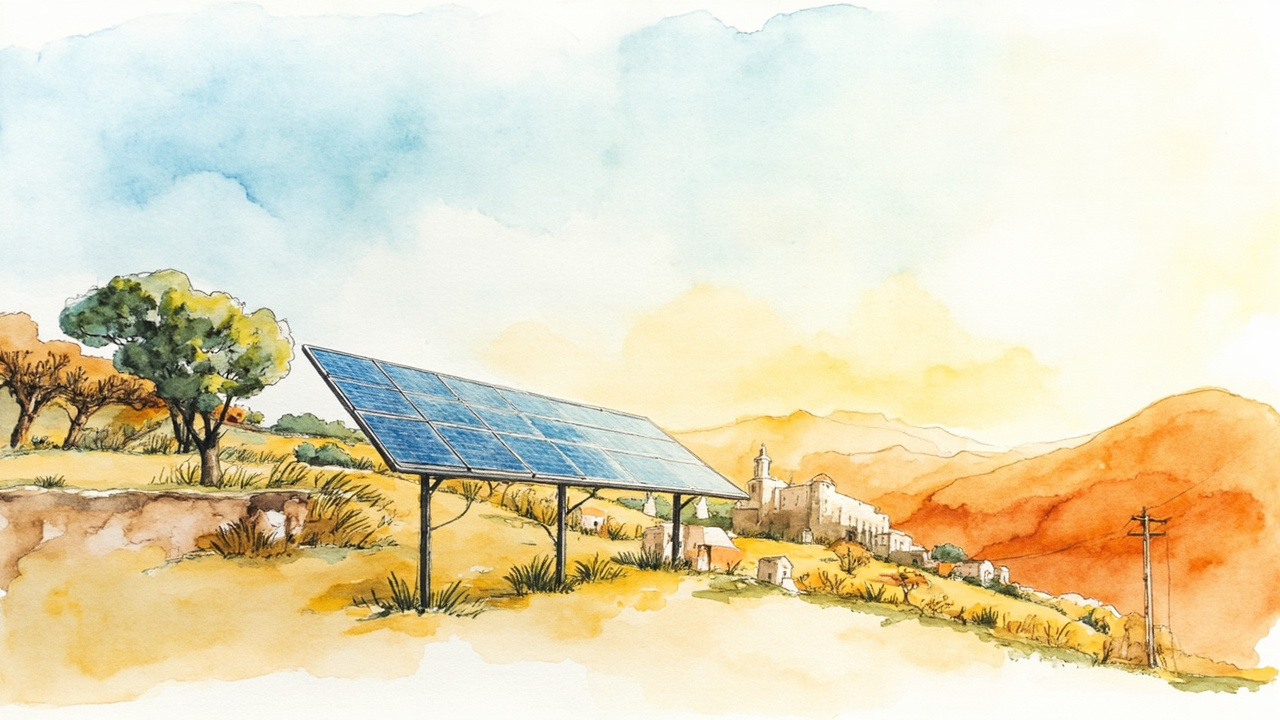
The Government of the Canary Islands agreed on October 19, 2026, to the execution of the Lomo Gordo 4 Photovoltaic Park, 2 MW, promoted by Tinojai Renovables, S.L.U. in San Bartolomé de Tirajana (Gran Canaria), and simultaneously ordered the modification of the affected territorial and urban planning. The decision is published in the Official Gazette of the Canary Islands (Boletín Oficial de Canarias) no. 215, dated October 27, 2026, through Decree 155/2026, which resolves the project’s non-compliance with the island planning warned by the Cabildo de Gran Canaria.
The decree is based on the exceptional procedure of Article 6 bis of Law 11/1997, of December 2, regulating the Canarian Electricity Sector, activated after Order no. 233/2026, of June 18, 2026, from the Counselor of Ecological Transition and Energy declared the works necessary to execute the project—processed under file ER225918—to be of general interest. The regulation provides that, if there is non-compliance with the planning, the regional Executive shall decide on the execution and, if applicable, order the adaptation of the planning instrument.
The text further details that the installation is located on the estate LG media fanega, on La Data mountain, on a plot of 164,015 m², and that the promoter issued a territorial compatibility urban planning report for the land on April 20, 2023.
Technical characteristics of the plant
- Solar field of 2,410 kWp consisting of 4,266 modules of 565 Wp each.
- Eight 250 kW inverters connected to a 2,000 kVA (0.8/20 kV) transformation center.
- Total peak power of 2,410 kWp and nominal power of 2,000 kW, with pure grid injection.
- 20 kV medium voltage underground line of 1,907 meters to the delivery center and the connection point on the UI_TABLERO line, of the Tablero Electrical Transformation Substation.
Contradictory reports on planning
The Insular Cabildo of Gran Canaria reported on September 23 and 30, 2026, that the project is non-compliant with the island planning, both with the PTEOTI/GC and the PIOGC22. In contrast, the General Directorate of Territorial Planning and Territorial Cohesion pointed out on September 30 that the action is located on land classified as Developable Land by the General Planning Plan of San Bartolomé de Tirajana, approved in 1996, and that the energy use is compatible with zoning C.2.2 and authorizable according to the minimum implementation conditions on rustic land of the PIOGC.
The file accumulates several procedures:
- Public information and consultations with affected administrations, July 25, 2023.
- Agreement of the Regional Environmental Evaluation Commission (CAEA), dated March 14, 2025, certifying the exemption from an environmental impact statement as it does not exceed the thresholds of Law 21/2013.
- Hearing with the Cabildo de Gran Canaria and the City Council of San Bartolomé de Tirajana, June 22, 2026.
- Evidence that the City Council did not issue a report on the project’s conformity with current planning.
- Proposals from the Director General of Energy dated September 2 and October 9, 2026.
Energy urgency and expected return
The agreement invokes reasons of urgency and exceptional interest linked to the Climate Emergency Declaration of August 30, 2019, which sets decarbonization for 2040, and the Energy Emergency Declaration of October 2, 2023. It also certifies that the project is not agrivoltaic, therefore it does not require the favorable agriculture report provided for in the fifth final provision of Decree-law 5/2024.
The positive impacts listed in the decree are:
- Contribution of 5,616 MWh/year to the Gran Canaria electrical subsystem.
- Savings equivalent to 1,617 tons of oil per year.
- Reduction of 4,358 tons of CO2 per year.
- Approximate investment of 1,498,459 euros.
- Contribution to the goal of 180 MW of photovoltaics in Gran Canaria, currently at 142.18 MW.
The decree orders the modification of the planning “on the occasion of the first substantial modification thereof” and legitimizes the acts of construction and land use by itself. Against this act, which ends the administrative route, an optional appeal for reversal may be filed before the Government of the Canary Islands within one month, or a contentious-administrative appeal before the High Court of Justice of the Canary Islands within two months. The text is signed by President Fernando Clavijo Batlle and by the acting Councilor for Tourism and Employment, Jéssica del Carmen de León Verdugo.
For the municipality and for the renewable deployment of the island, the decision sets a relevant precedent: the regional Executive can authorize a 2 MW plant on developable land without detailed planning and overriding the criteria of the Cabildo, subsequently forcing the rewriting of the island’s planning.
Source: Official Gazette of the Canary Islands, no. 215, October 27, 2026, section III. Other Resolutions, page 38848 (official reference: boc-a-2026-215-3705).