Diario Oficial de Castilla-La Mancha · 30 Oct 2026 · 6 vistas
Favorable environmental report for a macro-farm of 270 calves in Atalaya
Por FactBox Admin
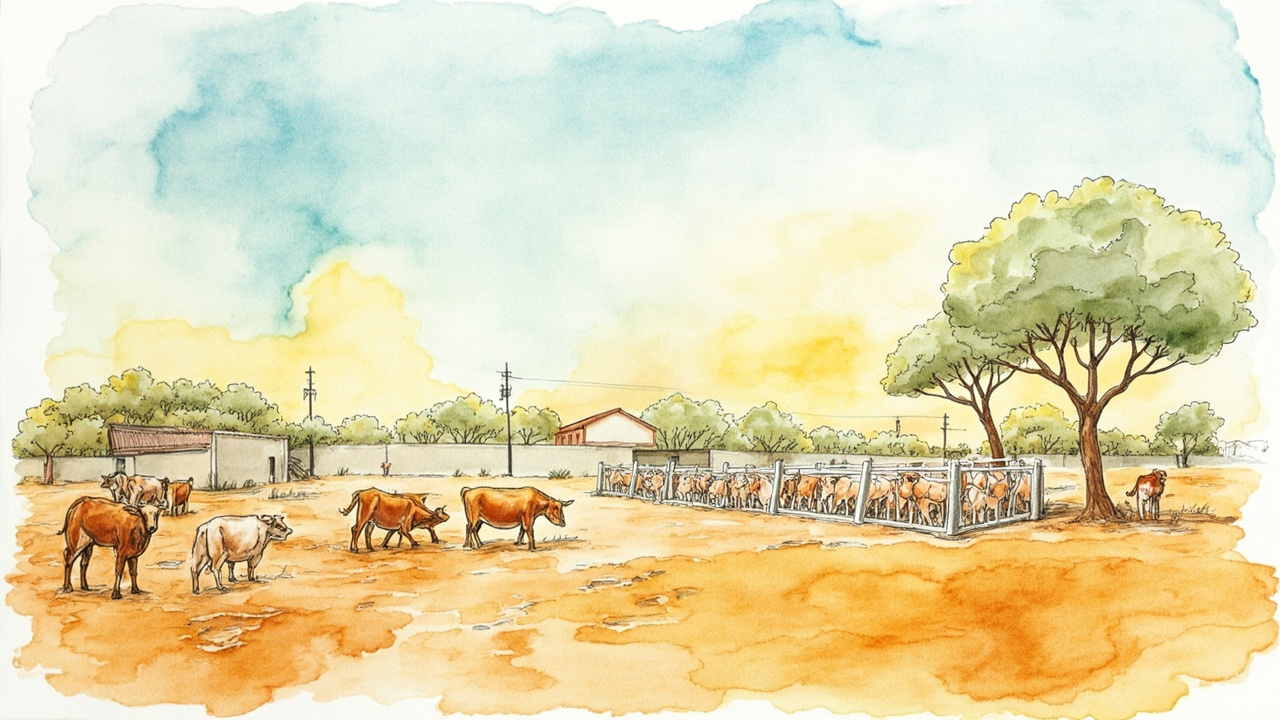
The Provincial Delegation for Sustainable Development of Cuenca has ruled that the intensive cattle fattening operation planned in Atalaya del Cañavate (Cuenca) does not need to undergo an ordinary environmental impact assessment. The environmental impact report, dated October 22, 2026, is published in the Official Gazette of Castilla-La Mancha number 209 of October 30, 2026, under official reference 2026/7768. The farm, with a capacity for 270 calves, will be located 245 meters from the urban center and 135 meters from sports facilities.
The project promoter is Gonzalo Blasco Prieto, while the substantive body is the City Council of Atalaya del Cañavate. The processing falls under Annex 2 of Law 2/2020, of February 7, on Environmental Assessment of Castilla-La Mancha, which subjects intensive livestock farms located less than 2,000 meters from residential urban land to a simplified assessment when they exceed 40 LSU (Livestock Units). The administrative file is S478/2026/CU/00081, initiated with the application submitted on February 5, 2026.
The matter has an immediate precedent: on September 21, 2026, the City Council of Atalaya del Cañavate published in the Official Gazette of Castilla-La Mancha number 181 (2026/6643) the public information announcement for urban classification file 2/2026, signed by Mayor Alberto Catalán Perucho, with a twenty-day period for allegations.
A 1,327-square-meter warehouse next to the Pozo road
The project is located on plot 60 of polygon 506, with cadastral reference 16026A506000600000GI, a total area of 4.37 hectares of herbaceous crops on rustic reserve land. Access is via the “Del Pozo” road, which starts from the urban center itself.
The planned facilities are as follows:
- Main warehouse of 1,327.81 m² with a metal structure and concrete floor.
- Ten pens of 707.7 m², separated by mobile fences.
- Shed of 184.36 m², warehouse of 17.5 m², and changing rooms of 9.75 m².
- Quarantine area (lazareto) of 70.77 m², chute of 51.67 m², and corridor of 160.26 m².
- Waterproofed manure pit of 195.17 useful m².
- Perimeter fencing 435 meters long and two meters high.
- Watertight tank of 1,000 liters for sewage and electrical supply via a rooftop photovoltaic installation.
The operation is classified as a bovine fattening unit of group II of Royal Decree 1053/2022, with 162 LSU (270 animals at 0.6 LSU per head). The calves will enter at two months old and 100 kilos and will leave at 450-500 kilos after about ten months, with a sanitary void of 15 days between cycles. It will generate 972 m³ of manure per year, which will be distributed across plots in Atalaya del Cañavate, Cañada Juncosa, and El Cañavate.
Winds with impact on the town and archaeological protection
The wind study provided by the promoter, prepared using data from the El Picazo SIAR station between 2020 and 2025, admits “a certain incidence on the residential area although not predominant,” in 8-14% of monthly observations. Three other livestock farms are located within a two-kilometer radius. The A-3 highway runs 400 meters away, and the tributary stream of the Lavadero stream is 110 meters to the north.
The municipal urban compatibility report, dated May 8, 2026, classifies the plot as non-developable land under cultural protection, as it is located approximately 130 meters from the town center and within the A1 “Las Descalzadillas” archaeological area. The Provincial Delegation of Education, Culture, and Sports issued a favorable report on June 12, 2026, on the condition that the ethnographic element “Era de Vallejo de las Colmenas” (07160260020) is not affected and must be demarcated.
Water, the most delicate point
Consumption is estimated at 30 liters per animal per day, approximately 3,000 m³ annually, although the Guadiana Hydrographic Confederation raised the calculation to between 2,160 and 6,750 m³ per year for drinking water alone. The municipal plenary certified on August 17, 2026, that there was no impediment to providing service, but on October 20, 2026, the City Council communicated that emergency works on the Tajo-Segura aqueduct (Tubería Manchega), with an estimated timeframe of four to five months, require prioritizing the population’s water supply.
Therefore, the report requires justification of the normality of the supply before authorizing the activity and sets a detailed set of conditions: low-protein diets, vegetative barriers toward the municipality, leak-proof transport of manure avoiding passage through urban centers, wind direction control, and a manure production and management plan submitted to the Provincial Delegation of Sustainable Development of Cuenca.
Administrations and entities such as SEO/BirdLife, Ecologistas en Acción-Cuenca, Esparvel, and WWF/Adena were consulted, in addition to the San Clemente Regional Agricultural Office, the Urban Planning Service, and the State Roads Demarcation in Castilla-La Mancha, among others.
The report concludes that no irreversible or severe effects are expected and that the impact will be “compatible with the environment,” although it reminds that monitoring is the responsibility of the City Council and that the ruling expires in four years, extendable by two, without project authorization.
Source: Official Gazette of Castilla-La Mancha, no. 209, October 30, 2026, III.- Other provisions and acts, page 38859 (official reference: 2026/7768).