Boletín Oficial de Castilla y León · 14 Sep 2026 · 2 vistas
Favorable environmental report for the La Loma hybridized solar plant in Burgos
Por FactBox Admin
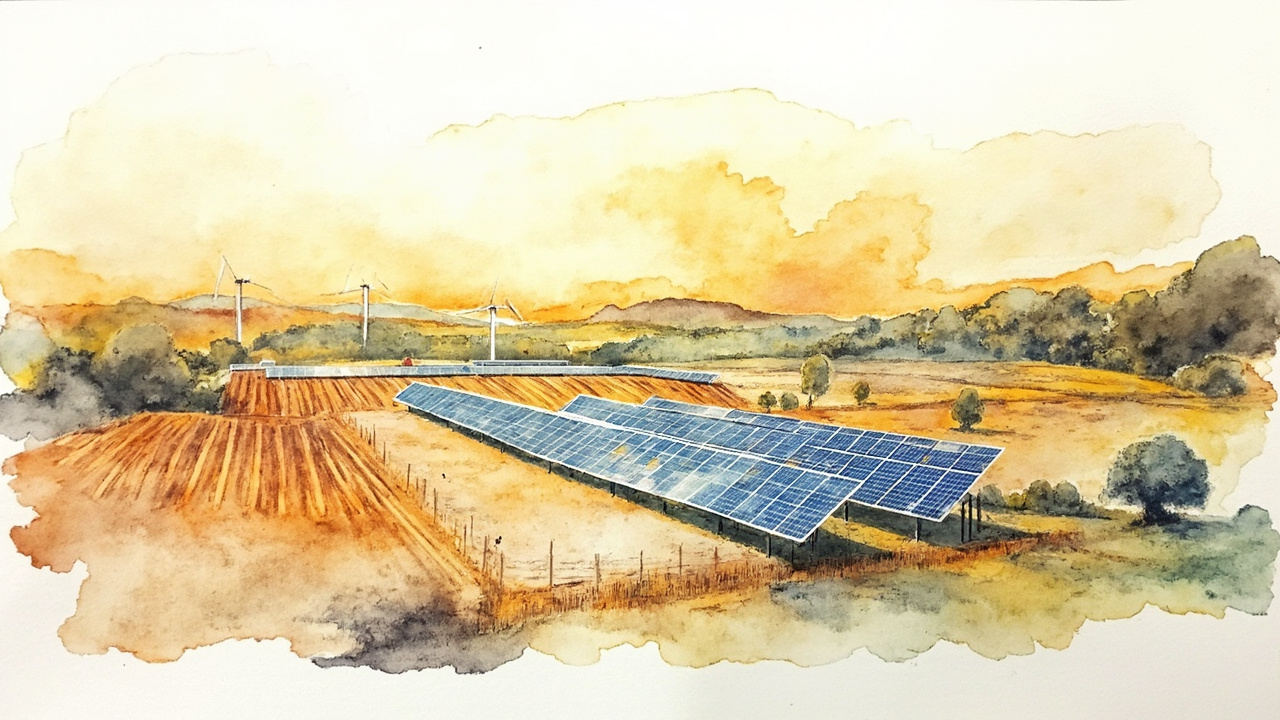
The Territorial Delegation of the Junta de Castilla y León in Burgos has issued the environmental impact report for the “La Loma” hybridized solar photovoltaic plant project and its evacuation infrastructure, in the municipality of Valle de Santibáñez (Burgos). The resolution, signed on September 8, 2026, by the territorial delegate Roberto Saiz Alonso, concludes that the project has no significant adverse effects on the environment and is published in the Official Gazette of Castilla y León number 178, dated September 14, 2026 (official reference BOCYL-D-14092026-178-17).
The file, number EIAS/2026/BU/006, is promoted by Estudios y Proyectos Pradamap, S.L.U., with registered offices at calle Miguel Ángel 11 in Madrid. The report is issued under article 11.2 of Law 21/2013, of December 9, on environmental assessment, and article 52.2 of the revised text of the Environmental Prevention Law of Castilla y León, approved by Legislative Decree 1/2015, of November 12.
A 42 MW hybrid project
The “La Loma” photovoltaic plant will have a nominal capacity of 13.685 MW and will be hybridized with the operating wind farm of the same name, which has 28.6 MW, resulting in a hybrid wind-photovoltaic plant of 42.285 MW. The maximum connection and evacuation capacity to the grid will be 28.6 MW.
- Total occupied area: 39.23 ha, configured in 5 fenced enclosures with 5,797 m of fencing.
- 23,324 bifacial photovoltaic modules of the Risen RSM132-8 685BHDG model, 685 Wp.
- 833 single-axis trackers and 7 Power Electronics FS1955K inverters.
- 4 transformation centers.
- Underground evacuation line of 30 kV and 785 m to the “La Loma” 30/132 kV transformer substation, which is already existing and operational.
Access will be via rural roads coming from the BU-V-6066, which connects La Nuez de Abajo with Avellanosa del Páramo. The nearest population centers are Zumel (803 m), La Nuez de Abajo (867 m), and Avellanosa del Páramo (1.89 km).
Processing and consultations
The simplified environmental assessment procedure began on February 24, 2026, with the submission of the application to the Territorial Environmental Service of Burgos, and the consultation process opened on March 2, 2026. The proposed resolution was reviewed by the Territorial Commission for Environment and Urban Planning of Burgos on September 1, 2026.
Among the consulted bodies, responses were received from the Duero Hydrographic Confederation, the General Directorate of Natural Heritage and Forestry Policy, the territorial services of Culture, Urban Planning, Roads, and Agriculture, and the Civil Protection Section. The Provincial Council of Burgos, the City Council of Valle de Santibáñez, and Ecologistas en Acción de Burgos did not respond.
The report concludes that the project does not territorially overlap with Natura 2000 Network sites nor affect other protection figures, and that it will not cause harm to the integrity of any protected area. The nearest Natura 2000 site, the SAC “Riberas del Río Arlanzón y afluentes,” is located 1.33 km away.
Conditions and validity
Among the required measures, the following stand out: prior intensive archaeological prospecting, permeability of fencing for wildlife, an anti-reflective treatment on the modules, and a perimeter planting of juniper and holm oak. The promoter must submit a program of compensatory measures and an environmental monitoring program to the Territorial Environmental Service of Burgos.
The environmental impact report will lose its validity if the project has not been authorized within four years of its publication. The substantive body must send an extract of the content of the authorization or denial to the BOCYL within ten days of the decision.
The resolution represents a key step for the hybridization of renewable energies in the province of Burgos, by leveraging the existing evacuation infrastructure of the wind farm to add photovoltaic generation without new overhead lines. The project reinforces the regional renewable transition and the decarbonization of the electrical system, although it entails a transformation of agricultural land that must be offset by the imposed environmental measures.
Source: Official Gazette of Castilla y León, no. 178, September 14, 2026, section I.D Other Provisions, pgs. 125-147 (official reference: BOCYL-D-14092026-178-17).