BOE · 19 Oct 2026 · 4 vistas
The invasive species catalog now includes minipigs and their hybrids
Por FactBox Admin
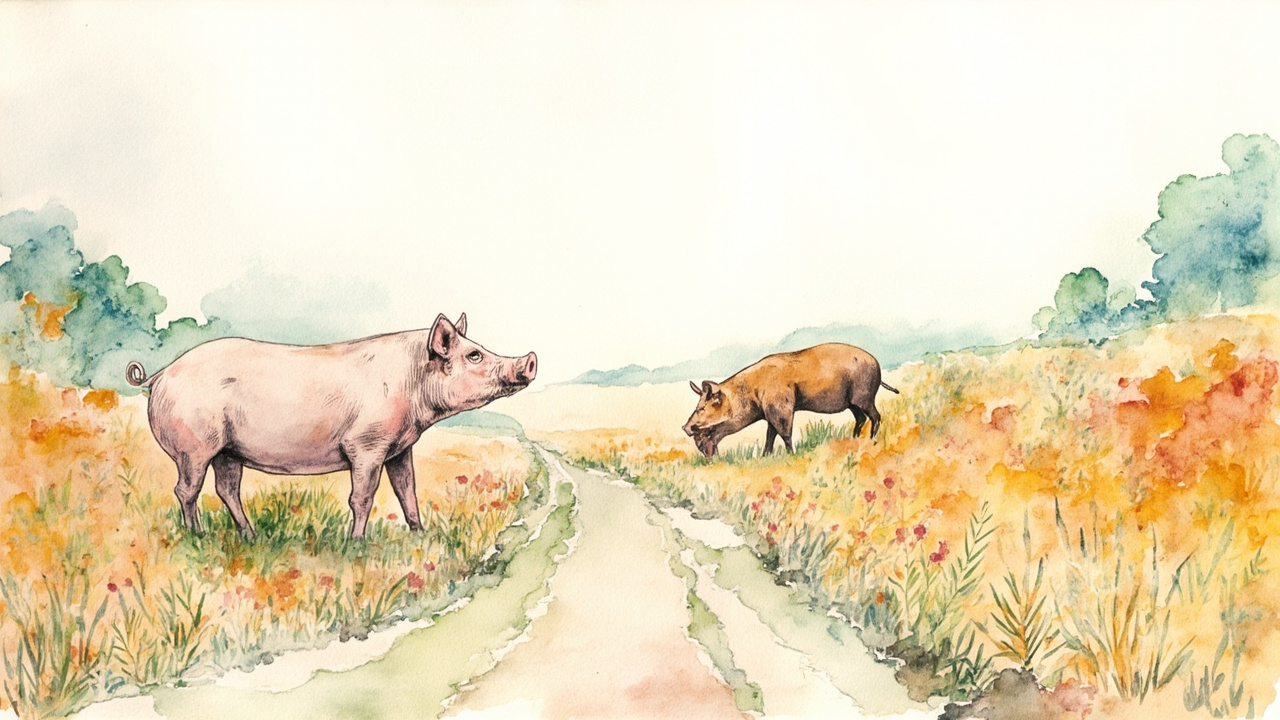
The Ministry for the Ecological Transition and the Demographic Challenge has included the Vietnamese pot-bellied pig, all its hybrids, and so-called “minipigs” in the Spanish Catalogue of Invasive Alien Species. This is done through Order TED/1096/2026, of October 6, published in the Official State Gazette (BOE) no. 259, this Monday, October 19, 2026, in section III, starting on page 139702 (official reference BOE-A-2026-21770). The order enters into force the day following its publication, that is, this Tuesday, October 20.
The regulation modifies the annexes of two royal decrees: Royal Decree 139/2011, of February 4, which develops the List of Wild Species under Special Protection and the Spanish Catalogue of Threatened Species, and Royal Decree 630/2013, of August 2, which regulates the Spanish Catalogue of Invasive Alien Species. It is signed by the third vice president of the Government and Minister for the Ecological Transition and the Demographic Challenge, Sara Aagesen Muñoz, and is issued under article 149.1.23.ª of the Spanish Constitution, which grants the State exclusive competence over basic environmental legislation.
The text recalls that both instruments are “dynamic tools subject to permanent updating.” The List and the Catalogue of threatened species had accumulated eight ministerial updating orders, the last being Order TED/452/2025, of May 5; the Catalogue of invasive species had been modified following the Supreme Court ruling of March 16, 2016, by Royal Decree 216/2019, of March 29, and by orders TED/1126/2020, TED/339/2023, and TED/452/2025.
The Vietnamese pig and its crosses, within the catalogue
The most visible change affects the mammals section. The reference to the subspecies “Sus scrofa var. domestica Vietnamese breed” is replaced by Sus scrofa var. domestica, a taxonomic precision requested by one autonomous community and “generally” supported by the others. With this, it is clarified that the set of hybrids, including so-called “minipigs,” is covered by the catalogue.
The scope of application is detailed precisely:
- Specimens kept as pets.
- Animals free in the natural environment.
- Specimens present in zoological centers, including pet shops.
- Animals that are part of agricultural holdings, considered zoogenetic resources, are excluded and in no case included.
The Ministry maintains that this taxonomic note “will allow for better control and management of the taxon by the competent administrations.” The exclusion of agricultural holdings is based on the third additional provision of Law 42/2007, of December 13, on Natural Heritage and Biodiversity, and on article 1.2.c) of Royal Decree 630/2013.
Seven new invasive taxa and more control in the Balearic Islands
The second article incorporates seven taxa into the Catalog of invasive species. Two are invertebrates, specifically ants: Crematogaster castanea and Messor cephalotes. The other five are flora: Axonopus fissifolius (carpet grass), Paspalum notatum, Paspalum vaginatum, Stenotaphrum secundatum (St. Augustine grass), and the genus Hydrocharis, with the exception of Hydrocharis morsus-ranae, a native species cataloged as “endangered.”
Only the genus Hydrocharis followed the procedure of article 5 of Royal Decree 630/2013. The other six taxa are incorporated via article 3.4 of Royal Decree 570/2020, of June 16, following unfavorable evaluations of their import authorization requests, which confirmed their ability to compete with native species or alter ecological balances. The proposal originated from the General Directorate of Biodiversity, Forests and Desertification.
Additionally, at the proposal of the autonomous community of the Balearic Islands, the scope of the Colubridae family is extended to the entire archipelago, having previously been limited to the Pityusic Islands. Native species are excepted: the Mauritanian smooth snake (Macroprotodon mauritanicus) and the viperine snake (Natrix maura) in Mallorca and Menorca, and the ladder snake (Zamenis scalaris) in Menorca.
New protected species: bumblebees, sarda, and seahorse
The first article reinforces the protection of fauna and flora. Four bumblebees enter the “endangered” category: the confused bumblebee (Bombus confusus), Cullum’s bumblebee (Bombus cullumanus), the monkshood bumblebee (Bombus gerstaeckeri), and the unexpected bumblebee (Bombus inexspectatus). The freshwater fish sarda (Achondrostoma salmantinum) is also included in the same category.
Two hoverflies, Mallota dusmeti and Meligramma cingulata, and the long-snouted seahorse (Hippocampus guttulatus), which previously only appeared on the List, are cataloged as “vulnerable.” The Alcon blue butterfly (Phengaris alcon), the bryophytes Dicranum viride and Pyramidula tetragona—included in Annex I of the Bern Convention—and the plant Narcissus calcicola, from Annex IV of the Habitats Directive 92/43/EEC, are incorporated into the List.
The processing included a hearing and public information, consultation with the autonomous communities and Ceuta and Melilla through the State Commission for Natural Heritage and Biodiversity, the State Council for Natural Heritage and Biodiversity, reports from the scientific committee, and an opinion from the Council of State.
The impact is twofold for the reader. Those living with a Vietnamese pig or a “minipig” now possess an animal of a species classified as invasive, with the corresponding control and management obligations, while zoological centers and pet shops must adjust to the new designation. In parallel, the order expands the Spanish biodiversity protection network with eleven taxa, including both threatened and invasive species, and extends the control of grass snakes to the entire Balearic archipelago.
Source: Official State Gazette, no. 259, of October 19, 2026, section III, page 139702 (official reference: BOE-A-2026-21770).